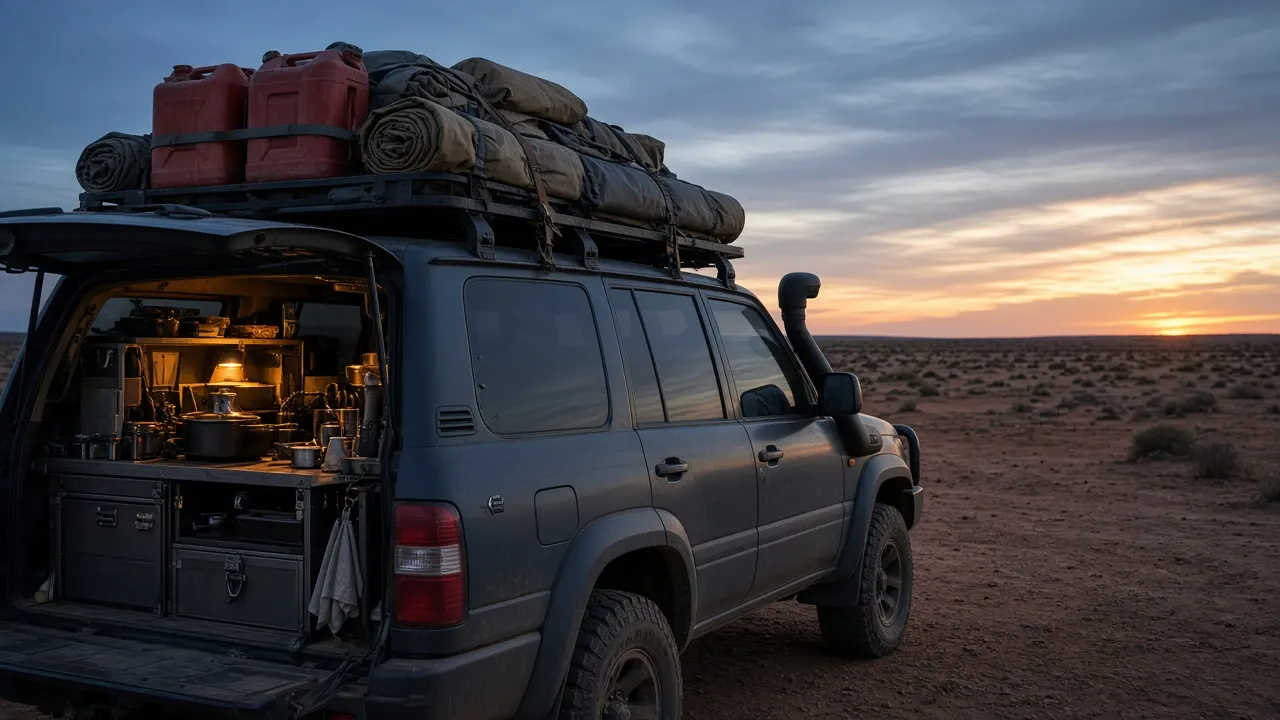
Remote-trip preparation fails in a predictable way. People spend weeks choosing a fridge slide and an afternoon on the thing that actually stops a journey: a belt, a tyre, a missing permit, a crew that did not agree on turnaround times. This page is a sequence. Follow it in order and the vehicle becomes a tool again instead of a personality.
1. Decide what the trip is asking
Write one paragraph that names the landscape, the longest day, the hottest likely week, the water sources you are not counting on, and the tenure stack. “Cape York in the dry, creeks still to be judged, Aboriginal-land camps, two spare days” is a plan. “Go north and see” is a hope.
That paragraph drives everything else. Desert heat changes water. Beach salt changes recovery and rinsing. High Country cold changes sleeping systems and the meaning of a late start. If you cannot name the landscape, stop and read the relevant guide first: beach, desert or High Country.
2. Inspect the vehicle as a system
A remote 4WD is not a showroom specification. It is a set of systems that have to keep working at walking pace, at full lock, and after a day of corrugations.
Cooling. Check hoses, the radiator for debris, the viscous or electric fan behaviour, and the history of overheating — especially if the vehicle tows or runs a heavy electrical load at low speed. Desert and dune work is a radiator test.
Charging and electrics. Confirm the start battery and any auxiliary battery are holding, the alternator is charging under load, and earths are clean. A fridge that works at home can flatten a tired system on a hot idle. If you carry a winch, the electrical path to that winch is part of the inspection, not an afterthought.
Tyres and wheels. Match tyres to the load and the country. All-terrain rubber is the usual remote compromise; mud-terrains have their place and their road manners. Inspect sidewalls, the spare, and the tools you need to change a wheel on a slope. Pack plugs and a compressor you have already used, not one still in a box.
Brakes, steering, suspension. Corrugations find worn bushes and tired shocks. A pre-trip inspection by someone who understands loaded remote work is worth more than a new accessory cover.
Underbody and recovery points. Look at the things that hit the country: sills, tanks, lines, and the points you will actually pull on. Recovery points must be rated and attached to the vehicle’s structure. A tow ball is not a recovery point. The recovery guide explains why that sentence is not negotiable.
Fluids, filters, belts, hoses. Carry what you cannot walk to a parts counter for. The exact spares list depends on the vehicle. The principle does not: if a part is known to strand that model far from help, it belongs in the box.
3. Load for a delay, not for a catalogue
Weight is a handling and fuel problem. Every kilogram should answer a job.
Water. Drinking water is a safety system. Heat, exertion and a stranded afternoon change the maths. Calculate from your crew and the weather, then add a reserve that assumes a source on the map is dry, closed or unpalatable. Do not invent a universal litre-per-day figure and treat it as law — people, heat and cooking styles differ — but do not leave home on a desert or Cape trip with “we will buy water later” as the plan.
Fuel. Map the longest plausible gap, including a closed road that forces a backtrack. Your own consumption, loaded, in sand or on corrugations, is the only honest number. Then add a reserve that would still get you to the next confirmed supply if one bowser is empty.
Food and cooking. Simple food that works when you are tired beats clever food that needs a town. Carry a way to cook that does not depend on a single gas bottle you cannot replace.
Medical. A kit matched to the crew’s actual conditions, plus personal medicines in more than one bag. Remote travel is a poor time to discover you packed the blister kit and left the prescription at home.
Repair and recovery. Shovel, boards, rated straps, shackles that belong on those straps, gloves, damper, compressor, puncture repair, and the winch kit only if the winch is serviceable. If a piece of kit has no one on the crew who has used it, it is decoration.
Sleep and weather. The High Country at the shoulder of the season is not the Simpson at night, and neither is a tropical coast. Pack for the 3 a.m. version of the forecast, not the midday brochure.
4. Collect permissions as a stack
Paperwork is part of preparation because a closed gate does not care how well the vehicle is built.
For each day of the route, name the manager:
- park or reserve conditions and any vehicle-access permit
- camping booking or designated-site rules
- Aboriginal-land transit or visitor permit
- local-government beach or foreshore permit
- fire restrictions and total-fire-ban behaviour
- biosecurity or clean-down requirements where they are published
Queensland Parks and Wildlife Service, Parks Victoria, DEECA, DBCA, NT Parks and Wildlife, National Parks and Wildlife Service South Australia, Parks Australia, land councils, and councils all publish in different places. Download the pages. Do not assume a pass from one system covers the next.
We will not quote fees. Fees change. The issuing page is the only figure that matters on the day you pay.
5. Communications and intentions
Preparation that cannot call for help is incomplete. A registered 406 MHz personal locator beacon is the distress instrument Australian search and rescue is built around — Australian Maritime Safety Authority registration is part of owning one, not an optional extra. A satellite messenger or satellite phone is how you change a plan without turning that change into an emergency. Mobile phones are a bonus on some ridges and a paperweight in many gorges.
Leave a written intention with someone at home: route, camps, device identifiers, vehicle description, and the time at which they should treat silence as a problem. The remote-area safety guide expands this because it is the page people skip when they are busy buying recovery boards.
6. Brief the crew like adults
Agree turnaround times before the first spectacular side track appears. Agree who is in charge of a recovery, who watches the line, and who is allowed to say no. Agree that a closed sign ends the debate. Agree that alcohol and driving a loaded 4WD on a remote road do not share a seat.
If children or less experienced drivers are on the trip, the briefing includes heat, reversing, and staying in sight at creek edges. Remote country is not a paddock.
7. The day-before pass
The night before you leave, do the unglamorous pass: torque the wheel nuts you touched, check the fridge is actually cold, confirm the PLB is registered and the satellite device has a clear view in the driveway, print the permits, and look at the park conditions page one more time. Then look at the fire map and the weather. If the notice has changed, the plan changes. That is preparation working.
A prepared 4WD is a quiet vehicle. It has water, a way home, a way to ask for help, and a crew that already decided what they will not do. The tracks in the iconic routes guide are still there if you arrive a day later. They are not improved by a departure that skipped the inspection.
Tools, parts and the honesty of your own vehicle
There is no universal spare-parts list that fits every 4WD sold in Australia. There is a list that fits your vehicle on this trip. Talk to someone who works on that model. Ask which hoses, sensors, wheel bearings or fuel filters are the ones that end remote days. Carry those, plus the tools that actually undo them, plus the knowledge that you will try a repair in daylight before you try it at 9 p.m. with one headtorch.
A tyre-repair kit is only a kit if someone has plugged a tyre before. A compressor is only a compressor if it has filled a tyre from the pressure you will actually use on sand. Practise in the driveway. It is unglamorous and it is the entire point.
If you tow a camper, the inspection includes the coupling, the safety chains, the breakaway, the bearings and the question of whether the desert or the beach is a place that camper should go at all. A trailer changes every recovery and every turning circle. It is not “the same trip with more comfort” unless the country is genuinely trailer country.
Money, time and the unfashionable reserves
Preparation includes the unexciting reserves: a way to pay for a sudden extra night in a town, a day off work that can move, and a crew agreement that turning around is a successful use of the plan. Remote Australia is expensive when something breaks, and this site will not invent the figure. What it will say is that a trip designed with zero slack is a trip that turns a small fault into a beacon conversation.
Look at the map for the last reliable town, not the last romantic name. Buy the water there. Refresh the park pages there. Send the home contact a message from there. Then go.
Questions people ask first
Each answer leads with the useful part, then the caveats that belong with it.
- How do I prepare a 4WD for a remote trip?
- Work through the vehicle as a system (cooling, charging, tyres, recovery points, lights), then consumables with reserves, then permits for every tenure, then communications and a written intention left with someone at home. Do that in order and most accessory arguments get smaller.
- How much water and fuel should I carry?
- Carry enough water for drinking, cooking and a delay, and enough fuel to cover the longest gap you might actually face if a bowser is dry or a road is closed. Exact litres depend on crew size, heat and the route — calculate from your own consumption, then add a reserve, rather than copying a stranger’s load-out.
- Do I need a second spare tyre?
- On remote corrugations and rock, a second spare is a common decision because a single spare is one puncture away from a walk. Whether you carry it depends on the route’s isolation and your ability to repair a tyre. Isolation is the test, not fashion.
- What documents should I print?
- Print or download offline copies of permits, booking confirmations, emergency contacts, and the park conditions pages you relied on. Reception will not improve because you need it.
Keep reading
- Remote-area safety
PLBs, satellite phones, trip intentions and heat. Communications that work when the mobile network does not.
- Recovery basics
Rated points, straps, boards and winches — the kit that belongs in the vehicle, and the habits that keep a recovery from becoming the emergency.
- Iconic 4WD tracks
Cape York, the Canning, the Simpson, the Gibb, K’gari and the High Country — what makes each route distinct, and which authority to ask before you go.