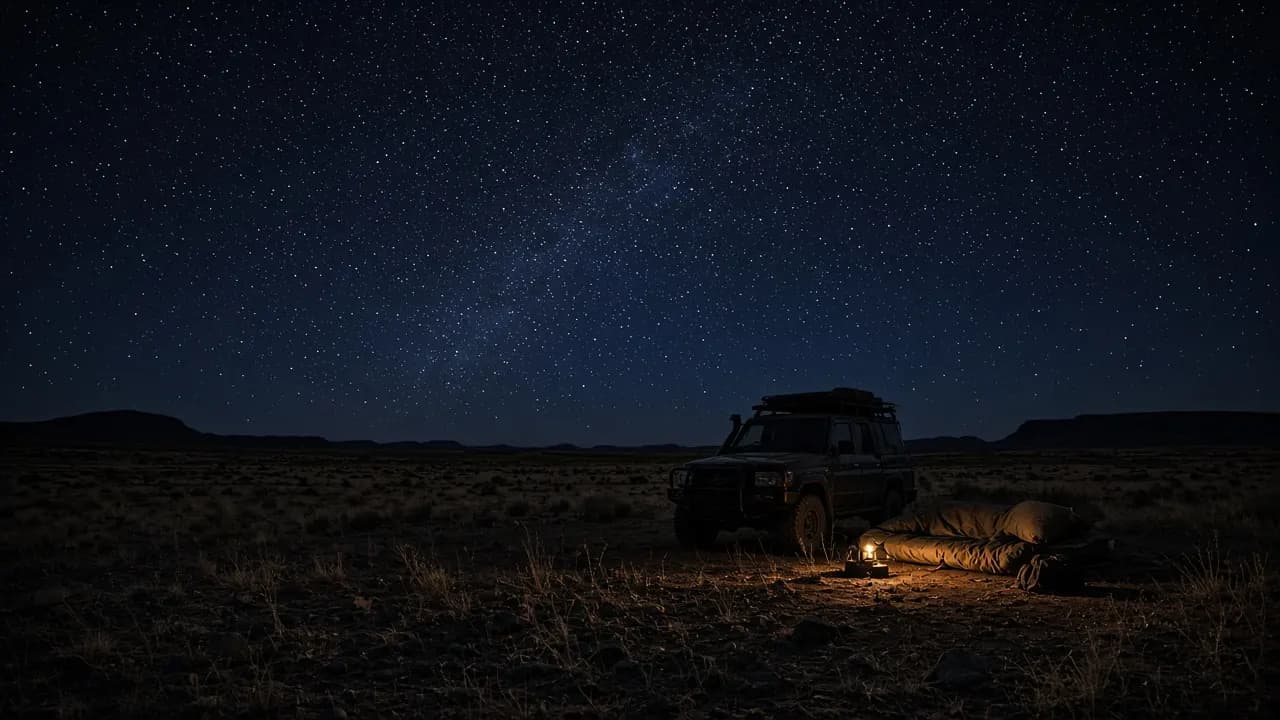
Remote-area safety is mostly dull: water, weather, a route that still works if a gate is shut, and a crew that sleeps enough to make good decisions. Communications sit on top of that dullness as the way you ask for help when the dull plan has failed, and the way you prevent a search by saying you are late on purpose.
This page answers the question people actually type — what to carry, PLB or satellite phone — and then puts those devices back in their place. A beacon does not hydrate you. A satellite phone does not make a flooded crossing shallower.
What each device is for
Mobile phone. Useful in towns, on some highways, and on the occasional High Country ridge. Useless in many gorges, dune fields, forest blocks and peninsula flats. Download offline maps. Do not build a trip around a carrier’s coverage map.
UHF radio. Excellent for talking to the vehicle behind you, to an oncoming truck on a narrow station road, and to a convoy on the same channel. It is not a search-and-rescue system. It is manners and close-range coordination.
Satellite messenger (two-way text). The practical everyday remote tool: “we are camped, we are a day late, we are turning around.” Many units include an SOS function that routes through a response centre. They need a view of the sky, a charged battery, and — for most models — an active service. They shine at preventing unnecessary worry.
Satellite phone. A voice conversation when a text is not enough: a medical description, a mechanical diagnosis, a changed pickup. Still needs sky view, battery discipline and a service that is actually paid. Still not a substitute for a dedicated distress beacon.
406 MHz personal locator beacon (PLB). A one-job device. You activate it when the situation is life-threatening or about to be, and you want search and rescue to start. Australian beacons are registered with the Australian Maritime Safety Authority so that an activation arrives with a name, a contact trail and medical notes you chose to supply. Test it only as the manufacturer allows. Do not pack it at the bottom of a locked drawer inside a vehicle you cannot reach after a rollover — wearability and immediate access are part of the kit.
HF radio. Still used by experienced remote travellers and some working traffic. It is a skill, an installation, and a set of schedules. If your crew already lives on HF, keep living on it. If nobody can make a radio sing, do not buy a tower of aluminium as a gesture.
Carry both a distress device and a conversation
The clean answer to “PLB or sat phone?” is distress and conversation are different jobs. A PLB is the distress job. A messenger or sat phone is the conversation job. Carrying both means a busted gearbox at dusk can be a text to the home contact rather than an activation, and a genuine medical emergency can still be a beacon if the messenger is smashed.
If you carry only one extra thing beyond a phone, make it the registered PLB. If you carry two, add the messenger. The sat phone is the third layer for crews who know they will need to talk.
Registration and the home contact
Register the beacon. Update the emergency contacts when they change. Tell those contacts what an activation would mean, and what a missed check-in would mean, because those are different phone calls.
Write an intention that a tired person can follow:
- who is travelling, and the vehicle (make, colour, registration)
- the route as a sequence of named places, not a vibe
- camps or nightly windows
- the satellite device type and any identifier the response centre would ask for
- the time at which they should treat silence as a problem, and who they should call first
Some parks and land managers ask for trip intentions or have call-in cultures. Use those as well. A home contact and a ranger notice are not rivals.
If you change the plan, send the change. Most “overdue” worry is a crew who took an extra night because the sunset was good and forgot that someone at home is still counting.
Heat, water and the slow emergencies
The communications kit will not be the thing that gets you if you ignore heat. Remote Australia injures people with dehydration, with a vehicle that becomes an oven, and with the decision to walk “just to the next rise” in the middle of the day.
Stay with the vehicle unless staying with it is the danger. A 4WD is a larger search object than a person, and it holds shade, water and the beacon. Walk only with a reason that survives daylight, and leave a note that says where you went.
Water planning belongs in trip preparation. On this page the reminder is simpler: when someone is confused, angry or silent in the heat, that is a medical problem, not a motivation problem.
Navigation and the honesty of “we are not sure”
Carry more than one way to know where you are: a paper map that covers the trip, a loaded offline digital map, and a person who can read both. GPS is superb until it is not — batteries, a wrong track file, a gorge that eats the sky.
If two navigation systems disagree, stop. The country does not care which app you prefer. The High Country in cloud and the desert at night are both good at confirming a wrong line.
Fire, flood and the notice you did not want
Check fire restrictions and flood warnings on the state emergency and park pages the morning you leave a town. A total fire ban changes stove and cigarette behaviour. A floodway with a closed sign is closed even if a previous set of tyre marks went through. Those marks do not owe you a result.
Parks Victoria, Queensland Parks and Wildlife Service, DBCA, NT Parks and Wildlife, National Parks and Wildlife Service South Australia and Parks Australia all publish condition changes. The iconic tracks page names which desk matches which famous route. This page says: believe the desk.
Activating a beacon
Activate a PLB when there is a threat to life, or when a situation will become that threat before anyone can reasonably reach you another way — a serious medical emergency, a vehicle fire you cannot control, a rollover with injuries, a person missing in hostile country.
Do not activate it because you are inconvenienced, out of fuel on a road that still has passing traffic, or embarrassed. Do not fail to activate it because you are embarrassed and someone is badly hurt.
Once it is on, keep it on, keep the aerial as the manufacturer describes, and stay as findable as you can. Use the messenger as well if you can still type, so the home contact is not hearing the news only from a stranger.
Medical, mechanical and the grey area
Most remote problems are not immediately a beacon: a puncture streak, a tired child, a fridge that died, a crossing that made you late. Those are messenger problems and home-contact problems. The grey area is the medical event that might get worse after dark, or the vehicle that is upright but cannot move in country where the next passer-by is a rumour.
Talk it through as a crew before you are in it. What would make you activate? What would make you wait until morning and text? Write those thresholds down if your crew is the sort that argues when tired. A beacon activation is a public system doing expensive, skilled work. Use it when that work is the right work. Do not avoid it because you do not want to be a story.
Carry a medical kit you have actually opened at home, and the skills that match what is in it. A bag of equipment nobody can use is weight. If someone in the crew has a condition that changes the meaning of a delay — diabetes, heart disease, anaphylaxis — that belongs in the intention you left at home and in the beacon registration notes AMSA allows you to supply.
Batteries, sky view and the driveway test
A satellite device that has never been turned on in the driveway is a hope. Confirm that the messenger can see the sky, that the home contact receives a test message, and that the PLB’s self-test — the one the manufacturer documents, not an invented activation — is current. Cold High Country nights and hot desert days both treat batteries badly. Pack charging that does not assume the vehicle will run all evening.
Gorges, dense forest and the lee of a dune can all hide a device from the sky. If you camp in a hole, know where you would walk to send a message. If you crash into a hole, the worn-on-the-person PLB is the device that still works.
UHF channels for convoy chat should be agreed before the first dusty hill. A radio that is on the wrong channel is a decoration. So is a radio nobody is listening to because they are wearing headphones.
Remote-area judgment is the habit of making the unspectacular choice while you still have choices. Communications kit is how you keep a bad day from becoming a silent one. Pack the beacon where a hand can find it, send the boring check-in, and let the country be the interesting part.
Questions people ask first
Each answer leads with the useful part, then the caveats that belong with it.
- What communications should I carry (PLB, sat phone)?
- Carry a registered 406 MHz personal locator beacon as the distress device, and add a satellite messenger or satellite phone if you need two-way contact to change plans or call a non-emergency problem. Mobile phones are useful where they work and irrelevant where they do not.
- Is a satellite messenger enough without a PLB?
- A messenger is excellent for check-ins and many have an SOS path, but a dedicated 406 MHz PLB remains the simple, battery-honest distress beacon that does not depend on a subscription remaining active. Many remote crews carry both so a plan change and a life-threatening emergency are not the same button.
- Do I need HF radio as well?
- HF (and some VHF/UHF networks) still matter for crews who travel as a radio culture or who need group comms in country with no satellite line of sight. For a small private trip, a PLB plus a satellite messenger covers the core jobs. Add radio if your group already uses it well.
- Who do I tell before I leave?
- A reliable person who is not on the trip, plus any park or land-council intention system that applies to the reserve. Give them the route, the devices, and the time that silence becomes their job.
Keep reading
- Trip preparation
How to ready a 4WD for remote travel: inspection, loads, water, fuel planning, and the paperwork park managers actually check.
- Desert crossings
Simpson and Canning country: multi-tenure permits, dune driving, and why park and land-council notices sit above any trip report.
- High Country
Victorian alpine tracks, seasonal road closures, and how Parks Victoria and DEECA publish the dates that matter.