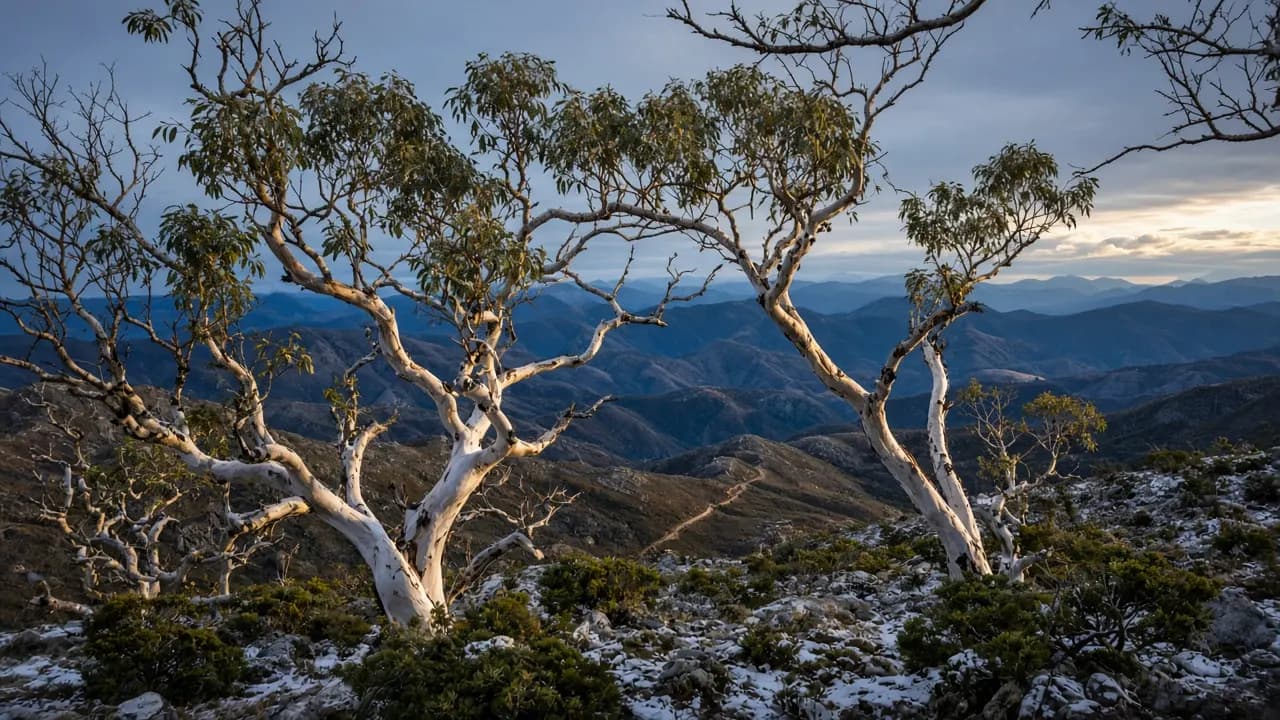
The Victorian High Country is a network of alpine and sub-alpine roads, river crossings, huts and forest blocks that feels, on a clear January day, like it was arranged for a 4WD. In July the same network is a wet, sometimes snowed, always erodible landscape that Parks Victoria would like to still have in November. Seasonal road closures are how that wish becomes a gate.
This page answers the closure question directly, then stays with how to plan High Country travel in the months the gates are open — and how not to import a Victorian date onto a different mountain.
How seasonal closures work
Parks Victoria states the purpose plainly: many roads and tracks are closed to vehicles through the wetter months so that the surface and the water quality survive for the warmer ones. The work is done in partnership with Four Wheel Drive Victoria, which is why club culture in Victoria tends to treat the list as a shared project rather than as an insult.
The usual window is after the King’s Birthday long weekend in June through to the end of October. Parks Victoria also says closures may be extended if conditions are not suitable to reopen safely. That sentence is doing a lot of work. A memory of “it opened in the first week of November that year” is not a plan.
The list is named roads in named parks and reserves, not a blanket over every alpine contour. Some connecting roads remain open. Some roads that you think of as “the High Country” are state forest under DEECA rather than national park. You need both desks.
Parks Victoria publishes:
- a seasonal road closures page that explains the system
- a current-year list of roads (as a downloadable document)
- maps, including a large map package in recent years
- MapShareVic as the spatial view of seasonal closures in parks and in adjoining DEECA country
- changed-conditions notices for storm, fire and other unplanned closures
If you read only a forum recollection, you are not reading the system.
How to use the list without fooling yourself
Download the current year’s list when you start planning, and look at it again the week you leave. Confirm the park name, the track name, and the fact that spelling varies — a hut name in your head may not be the road name on the list.
Then open MapShareVic and the changed-conditions listing. A track can be seasonally open and still closed because a storm took the crossing out. Parks Victoria’s 4WD safety notes also remind visitors to stay on formed roads, not to drive floodwater, and to travel as if the country can still be rough when it is “open”.
DEECA’s forest and road-closure pages cover the state-forest estate that weaves through the same mountains. If your loop uses both a national-park track and a forest road, you have two notices to honour.
This site will not reprint a year’s opening and closing dates track by track. Those dates belong on the Parks Victoria document that will be updated when the country is not ready. Copying them here would freeze a living list.
Planning a trip in the open months
High Country travel in the open season is still remote-ish travel. Phone coverage is patchy in folds of the range. Weather on a ridge can be a different season from the valley you booked in. River crossings rise after rain that you did not stand in.
Prepare the vehicle as the trip preparation guide describes, with extra attention to weather clothing, a way to stop a night becoming hypothermic, and navigation that still works in cloud. Carry the communications kit you would take somewhere quieter — a registered PLB is not only a desert object.
Recovery in the High Country is often about ruts, off-camber clay and a crossing that was honest yesterday. Boards help. A winch helps when a second vehicle cannot line up on a narrow bench. A strap still needs rated points. None of that is unique; the unique part is how quickly a mist can turn a simple reverse into a geography problem.
Huts are cultural heritage and sometimes shelter. Treat them as shared, finite places: no firewood raids that strip the next crew, no carving, no assumption that a hut is an emergency plan you do not have to carry.
Fire, hunting seasons and other people’s mountains
The High Country is working land. Fire restrictions in summer are as serious as winter gates. Hunting seasons, cattle on some licences, and walkers on the Australian Alps Walking Track all share the same maps. A 4WD is a guest with a wide turning circle. Slow down near camps and on blind crests.
If a road is closed for fire recovery or storm, do not invent a parallel pad beside it. That is how a temporary closure becomes a longer one, and how Parks Victoria’s conservation regulator ends up in a conversation nobody wanted.
Not only Victoria
People say “High Country” and sometimes mean the NSW Snowies, the Brindabella, or Tasmania’s central plateau and western forests. Those places have NSW National Parks and Wildlife Service, NSW Forestry, Parks Australia (for some Commonwealth land), and Tasmania Parks and Wildlife Service as the desks. Their winter closures, snow chains and booking rules are theirs. A Victorian King’s Birthday sentence does not travel.
If your trip crosses the NSW–Victoria alpine country, stack the notices the way this site stacks desert permits: one manager per tenure, the most restrictive notice wins.
Reading a High Country day
An open-season day in the Victorian ranges still asks you to think in weather systems rather than in hours. A valley can start clear and a ridge can close in. Pack a layer you will look overdressed wearing in the car park. Carry a way to make a hot drink that does not depend on a hut stove being stocked. If you cross a river in the morning, look at the sky and ask whether that river is the same river at 4 p.m.
Clay after rain is a different surface from the dust you practised on. Aired-down tyres help; so does the decision not to polish a climb into a slot that the next crew will inherit. If a track is a bog hole because everyone “just wanted to see”, you are now part of the reason Parks Victoria writes extensions into the seasonal system.
Snow can appear outside the months people associate with it. Parks Victoria’s own reserve notes — Mount Skene is a published example — mention snow well into the shoulder and the sense that weather is not obliged to follow a brochure. Carry chains only if you know how to fit them and if the road you are using is a road that still makes sense with them. A closed seasonal gate is not a chains problem. It is a gate.
Huts, camps and the people already there
High Country huts are part of the culture of these mountains and part of their heritage management. Arrive as a visitor to a shared room: leave it cleaner, do not treat firewood as infinite, and do not assume an empty hut is a booking. A tent or a swag that does not rely on the hut is still the grown-up plan.
Camps near rivers are pleasant and they flood. Look at the high-water marks. Look at the exit if the crossing behind you rises. The remote-area safety habit of telling someone your nightly window matters here too — a High Country fold can hide a vehicle from a search as effectively as a dune field.
Give walkers room. The Australian Alps Walking Track and countless shorter walks share these ranges. A 4WD that arrives in a hurry at a blind crest is the story nobody wants to be in.
Why the list is not an insult
Travellers sometimes talk about seasonal closures as if they were a lockout. They are a maintenance decision made in public. Wet alpine soils, water quality in catchments, and the simple fact that a stranded vehicle on a snowed ridge is a rescue are the reasons Parks Victoria and DEECA publish names and dates. If you want more tracks open in November, the way to get that is not to drive them in July.
Use the open months well. Travel slowly enough to keep the surface. Take the rubbish. Let the next crew find the same track you were glad to find.
The High Country is generous to travellers who treat a gate as a letter from the land manager, not as a puzzle. Read this season’s list, pack for a colder night than the car park suggested, and leave the wet tracks for the months they are meant to be driven. The iconic tracks guide is the wider map; this page is the alpine chapter with the dates left where they belong — on Parks Victoria’s current list.
Questions people ask first
Each answer leads with the useful part, then the caveats that belong with it.
- What are the Victorian High Country seasonal closures?
- Parks Victoria seasonally closes many High Country roads from after the King’s Birthday long weekend in June through to late October to protect wet tracks and water quality, and may extend closures if conditions stay unsuitable. Download the current-year list from Parks Victoria and check MapShareVic plus any changed-conditions notice before you go.
- Are all High Country tracks closed in winter?
- No. The seasonal list is specific — named roads in named parks and forests. Some lower or connecting roads stay open. Treat each track as listed or not listed, then still check storm and snow notices.
- Who else closes High Country roads?
- DEECA manages seasonal and event closures on some adjoining state-forest roads, and emergency agencies can close roads during fire or flood. A seasonal opening on a Parks Victoria list does not override those notices.
- Can I walk or ski a closed road?
- Many seasonal closures are about vehicles. Walking access can still exist, with its own hazards. Check the park page; do not assume a vehicle gate is a full reserve closure, and do not assume it is only a suggestion for drivers.
Keep reading
- Iconic 4WD tracks
Cape York, the Canning, the Simpson, the Gibb, K’gari and the High Country — what makes each route distinct, and which authority to ask before you go.
- Trip preparation
How to ready a 4WD for remote travel: inspection, loads, water, fuel planning, and the paperwork park managers actually check.
- Remote-area safety
PLBs, satellite phones, trip intentions and heat. Communications that work when the mobile network does not.